Friday, October 31, 2008

Family Search Indexing

This is based on an article I wrote for my Ward's Newsletter regarding Family Search Indexing. It is really fun and easy, and you don't have to be LDS to do it.

In September 1842, Joseph Smith wrote the following direction to the Saints concerning preparing family history records for temple ordinances:

“Let us, therefore, as a church and a people, and as Latter-day Saints, offer unto the Lord an offering in righteousness; and let us present in his holy temple, when it is finished, a book containing the records of our dead, which shall be worthy of all acceptation.” (D&C 128:24)

As individuals, we may need to change our thinking from me centered, to we centered, or from my ancestors to our ancestors.

Family Search Indexing is a program which ambitiously aims to catalog and index millions of rolls of microfilm providing census, vital, probate, and church records from over 100 countries. This work is done by volunteers of any age or faith. All information is made available free to the public, helping church members prepare names for temple ordinances and allowing the spirit of family history work to bless individuals across the globe. Your help is needed in this effort, including a special need for individuals who can read foreign languages. If you have a computer, Internet access, and a few minutes, you can help participate in Family Search Indexing from your own home. The process is easy, low pressure, and there is no paperwork involved.

If you want to learn more about Family Search Indexing, read the August 2007 Ensign article, Family Search Indexing, visit the website www.familysearch.org, or contact your local ward’s Family History Consultant.

Monday, October 27, 2008

The Spirit of God Like A Fire Is Burning


(The next in my series of blog posts about the Mormon hymns I have grown up with and loved. Since this is the second post, I officially have a series. So far I am going in order the hymns appear in the official Hymn book of the Church of Jesus Christ of Latter-day Saints, but I may change that if the mood strikes me!)

This post is about Hymn #2, The Spirit of God, by W.W. Phelps.
I can honestly say this hymn is a favorite. I know that I’ve said that they are all my favorites, and it’s true, but this is a favorite favorite. It’s probably in the top half of the top ten of my favorites.

I came across in interesting quote by Bruce R. McConkie that relates to how I feel about singing this song, "Music is given of God to further his purposes. Sweet melodies mellow the souls of men and help prepare them for the gospel. After men receive the truth, songs of praise to Deity help to sanctify and cleanse their souls." Mormon Doctrine (1966), 521

The Spirit of God was written by W.W. Phelps, who also wrote many other really great hymns which would be at the top of my list of favorite favorites as well. I have learned in the course of researching the hymns that the authors often wrote the text and then the hymn was sung to various different tunes that were familiar to the people. This hymn has been set to four different tunes, finally settling into the current version which goes by the tune name “Hosanna.” This explains why the LDS hymn book has an index of meters, and you can find that when the meters match, you can sing the words of different hymns to different tunes in the book. However this is an extremely difficult exercise when you have sung the same hymn to the same tune for 30 plus years. I don’t recommend it unless you have your thinking cap securely snugged down.

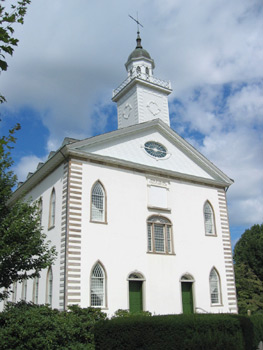
The hymn was sung at the dedication of the first Mormon temple in Kirtland and is sung still at the dedication of temples throughout the world.

The first stanza reads,

The Spirit of God like a fire is burning;
The latter day glory begins to come forth;
The visions and blessings of old are returning;
And angels are coming to visit the earth.

I love to sing this part, or play it on the piano, or listen to someone else play it, because as soon as I sing or think in my heart, “The Spirit of God” like a fire is burning, I start to feel the Holy Ghost testify of the truth of the doctrines the song teaches, feeding my soul, cleaning out the cobwebs and false ideas that clog up the ability to really ponder and understand the truths of the Gospel.

It’s thrilling to think of the Kirtland Temple dedication and the marvelous events that accompanied it. The Kirtland Temple was the first house of the Lord built in the latter days and was a place where several heavenly visitors came. Jesus Christ Himself appeared to Joseph Smith and Oliver Cowdery and accepted the Kirtland Temple as His house. Moses, Elias, and Elijah also came and gave Joseph and Oliver the authority to gather Israel and to seal families together forever. According to the research I did, Phelps wrote this text in January 1836, and the temple dedication was in March 1836.

An interesting thing to note is that there are two stanzas of the hymn that we don’t sing in modern congregations. The original stanza four speaks in the spirit of prophecy about these Kirtland events in even more detail,

Old Israel that fled from the world for his freedom,
Must come with the cloud and the pillar, amain;
A Moses, and Aaron, and Joshua lead him,
And feed him on manna from heaven again.

The chorus reads,

We'll sing and we'll shout with the armies of heaven:
Hosanna, hosanna to God and the Lamb!
Let glory to them in the highest be given,
Henceforth and forever: amen and amen!

This chorus invokes the Hosanna shout, an LDS ceremony performed when participating in a dedicatory service for a temple. It is accompanied by the members of the congregation waving a white handkerchief . The hosanna shout was performed in Jerusalem upon Christ’s triumphal entry into Jerusalem and signifies welcoming him both symbolically and physically into the world, our hearts, and the place of worship being dedicated. It acknowledges ceremonially that each of these are the Lord's as he has won them and then shared them with us through the Atonement. I love that these words are the words that repeat four times as we sing with the song.

I read that in the Community of Christ church, they have changed the first line to read “angels of heaven” and I like that idea. I understand the military symbolism, but I also like the idea that there are armies of angels in heaven.

The second verse reads,

The Lord is extending the saints' understanding—
Restoring their judges and all as at first;
The knowledge and power of God are expanding
The veil o'er the earth is beginning to burst.

In this verse, the hymns’ writer and performers acknowledge the vastness and completeness of the restoration of the Gospel. The tune is so powerful and triumphant, when I get to the line, "the veil o’er the earth is beginning to burst", it feels like Holy Ghost fireworks, almost like the Holy Ghost could be showing off a little if he could possibly do that.

Stanza three is a little more reserved in its tone, putting out a call to action of how we will play a role in spreading the Gospel and in building up the kingdom.

We call in our solemn assemblies, in spirit,
To spread forth the kingdom of heaven abroad,
That we through our faith may begin to inherit
The visions, and blessings, and glories of God.

I love the promise that these lines imply, that we are the inheritors of God’s nature as his children, and we have the right to access the visions and blessings and glories of God through our faith.

And the last verse has another wonderful Isaiah reference (you can rely on Isaiah to make the Gospel sound poetic and inspiring),

How blessed the day when the lamb and the lion
Shall lie down together without any ire
And Ephraim be crown'd with his blessing in Zion,
As Jesus descends with his chariots of fire!

It refers to Isaiah 11:6 "The wolf also shall dwell with the lamb, and the leopard shall lie down with the kid; and the calf and the young lion and the fatling together; and a little child shall lead them." This verse makes me think again of the hosanna shout, waving that white handkerchief in a symbol of welcome to the Prince of Peace.

Of course the last two lines of Stanza Four are thrilling as well, as we can envision the Lord’s triumphant return to the earth to claim his people as his own.

I am reminded of the scene in the Book of Mormon where the Lord calls down his angels from heaven to minister to the children of the Nephites:

“And as they looked to behold they cast their eyes towards heaven, and they saw the heavens open, and they saw angels descending out of heaven as it were in the midst of fire; and they came down and encircled those little ones about, and they were encircled about with fire; and the angels did minister unto them.”

The Spirit of God, it burns like a fire in my heart, a light and a warmth that illuminates, directs, protects, and cleanses, teaches, and sanctifies.

Friday, October 24, 2008

Limerick of the Day

Okay there is no limerick of the day feature on this blog, but there should be, because limericks make my heart sing.  So this one came to me today as I was walking back from lunch, thinking about writing Halloween poems with a bunch of 5th graders next week:

There was an old man named Bernanke,
Who supervised bank hanky-panky,
They spent the last dimes,
Making loans for sub-primes,
And made Mr. Bernanke cranky.

(and the stock market tanky)

Friday, October 10, 2008

The Morning Breaks


I’ve been thinking about things that I could blog about and an idea that keeps coming up is about how much I love the hymns of the Church of Jesus Christ of Latter-Day Saints. I have grown up with many of these songs and loved them throughout my life. It probably started with my mom being the Primary Chorister. I can still remember going to Primary on weekdays and helping my mom with Primary as a tiny tot. Whenever someone asks me what my favorite hymn is, I can’t decide. It’s like choosing a favorite son or daughter. All of them are my favorite. So I decided to start at the beginning of the (Mormon) hymnbook, my beloved readers, and respond to the hymns that move me the most.

The Morning Breaks.
The morning breaks; the shadows flee;
Lo, Zion's standard is unfurled!
The dawning of a brighter day,
The dawning of a brighter day
Majestic rises on the world.

The clouds of error disappear
Before the rays of truth divine;
The glory bursting from afar,
The glory bursting from afar
Wide o'er the nations soon will shine.

The Gentile fulness now comes in,
And Israel's blessings are at hand.
Lo, Judah's remnant, cleansed from sin,
Lo, Judah's remnant, cleansed from sin
Shall in their promised Canaan stand.

Jehovah speaks! let earth give ear,
And Gentile nations turn and live.
His mighty arm is making bare,
His mighty arm is making bare
His covenant people to receive.

Angels from heaven and truth from earth
Have met, and both have record borne;
Thus Zion's light is bursting forth,
Thus Zion's light is bursting forth
To bring her ransomed children home.

The text of this song was penned by Parley P. Pratt. It first appeared in print on the cover of the first issue of the long-running (1840-1970) LDS Newspaper, “The Millenial Star.” I came to love this hymn as a freshman at East High Seminary when I was privileged to participate in a Seminary choir in which we sang this song at the Tabernacle. I can’t remember the occasion, but I believe it was some kind of youth fireside.

First of all, I’m a complete sucker for any hymn that is considered a Restoration hymn, as well as any hymn that has an Isaiah scriptural reference, or any hymn that expounds on the vision of the future of Zion.

I love the imagery in this poem. The image in my mind is always of the day bursting forth over the Wasatch Mountains (of course in my mind they are covered with snow—they look best that way).  That daylight causing the shadows of dark to flee is so powerful. It is a wonderful metaphor analogous to the way that God’s power has been made manifest among his children with the Gospel spreading over the earth and deep into the hearts of men and women.

The Isaiah reference for this hymn reads,

“Arise, shine; for thy light is come, and the glory of the Lord is risen upon thee. For, behold, the darkness shall cover the earth, and gross darkness the people: but the Lord shall arise upon thee, and his glory shall be seen upon thee. And the Gentiles shall come to thy light, and kings to the brightness of thy rising.”

And this is exactly what has been happening since the Restoration. The darkness that once covered the earth has been overpowered by the light of the Lord that has arisen like the sun to shed light and knowledge into the world. When you look at the many advances in technology, medicine, science, political systems, and even in the goodness of humanity that have taken place in the latter days it is astounding.

I love it when the hymn is sung and the men sing alone with the first repeated line from each stanza, and then the women sing alone the refrain, and then the four parts together come in to finish the sentence. It is always so climactic and exciting to sing this part. (Plus, this song has an interesting alto part, which is always a plus for those of us who sing that part and are usually limited to the notes e, f, and g. As an aside, I learned an entire Mozart mass in college and literally those were the only three notes in the piece for altos).

The last verse of the hymn is the most exciting, although I am sure a lot of people have tired voices by the time they get through the first five. In this verse, Zion’s light, or the law, the doctrine, and the love of God, is bursting forth and providing a beacon that leads the “ransomed”, all of us who are saved through the Atonement, back to our home in the Lord’s presence. (How relieved we are to be ransomed, and how grateful to be on the path toward home!) The wonderful thing about that light is that it while it leads us, it also warms us, and enlightens us, and fills us up with its presence while we are still on the journey, not requiring us to wait until we arrive at the destination to feel the satisfaction and love of God.

The guiding light referenced in the song brings to my mind the pillar of light that Joseph Smith describes as being what he experienced in the first moment of the First Vision event,

“I saw a pillar of light exactly over my head, above the brightness of the sun, which descended gradually until it fell upon me.” And who was in the midst of the light? The one who said, “I am the light which shineth in darkness… Behold, I am Jesus Christ, the Son of God. I am the life and the light of the world” (See D&C 11).

Scripture References: Isaiah 60:1-3, 3 Ne: 16: 7-20

Interesting Links:

Ensign article about Parley P. Pratt
President Hinckley admired Parley P. Pratt
Text of this hymn appears on Parley P.Pratt’s grave marker
Story of the composition of the “Careless” version of the music